Mrs. Samsa
The MetamorphosisMrs. Samsa is Gregor Samsa’s mother and one of the principal witnesses to his transformation, confinement, injury, and death. She remains emotionally attached to the son who once supported the household, yet her physical frailty and horror at his altered body repeatedly prevent her from acting on that attachment. Her trajectory is defined by a painful contradiction: she wants to see Gregor as her unfortunate son and hopes that he may return to the family, but she also collapses before his appearance and ultimately accepts the household’s movement from care toward exclusion.
Identity and Family Position
Mrs. Samsa belongs to a family whose financial security had depended heavily on Gregor’s labor. After Mr. Samsa’s business collapsed five years earlier, Gregor worked with unusual intensity, advancing from junior salesman to travelling representative and placing his earnings at home so that he could support the whole family. Mrs. Samsa and the rest of the household accepted this money with gratitude, but they had also grown accustomed to depending on it. Gregor had planned to use his earnings to send Grete Samsa to the conservatory, a private hope he intended to announce on Christmas day. Mrs. Samsa therefore occupies the position of a dependent mother within a household whose emotional bonds have been entangled with economic obligation.
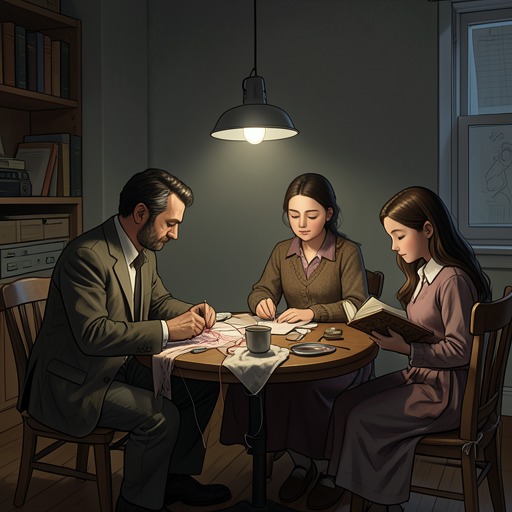
Her physical limitations are repeatedly emphasized through action. She cannot easily enter Gregor Samsa’s room, help move the heavy chest of drawers, or endure the crisis that follows his escape. The family’s distress is not only emotional: domestic work, cooking, sewing, cleaning, and income-earning must all be redistributed after Gregor loses his ability to work. Mrs. Samsa becomes part of that redistribution, helping with cooking while also sewing fancy underwear for a fashion shop, even as the family’s meals grow smaller and quieter.
First Response to the Transformation
At the beginning, Mrs. Samsa still addresses Gregor through the ordinary rhythm of work and family routine. She knocks cautiously at his door and reminds him that it is quarter to seven, asking whether he had meant to go somewhere. Gregor answers that he is getting up, but his voice has become almost unrecognizable, filled with a painful squeaking and an echo that makes his words unclear. Because the wooden door conceals the physical change, Mrs. Samsa accepts his explanation and moves away, leaving him temporarily protected by the barrier he has locked between himself and the family.
When Gregor finally opens the door for the Chief Clerk, Mrs. Samsa sees him in his transformed state. Her hair is still dishevelled from bed, and she first looks toward Mr. Samsa before unfolding her arms and moving toward Gregor. She then collapses onto the floor, her head sinking toward her breast. The gesture combines recognition, weakness, and shock: she does not attack him, but neither can she remain standing before the body that has replaced the son she knows.
Her response differs from Mr. Samsa’s immediate hostility. Mr. Samsa clenches his fists as if preparing to knock Gregor back into his room, while Mrs. Samsa falls helplessly and must be absorbed into the family’s defensive reaction. The contrast establishes her as emotionally attached but physically unable to mediate between Gregor and the others. She is neither a confident protector nor an active persecutor; she is a vulnerable member of the household whose fear helps sustain the closed-door arrangement.
Care, Hope, and the Threat of Abandonment
For the first fourteen days, Mrs. Samsa cannot bring herself to enter Gregor Samsa’s room. She and Mr. Samsa wait outside while Grete Samsa tidies the room, asking afterward what Gregor has eaten, how he has behaved, and whether any improvement can be seen. Her concern therefore remains active even when she cannot cross the threshold. She wants information about Gregor’s condition, and she treats the possibility of improvement as something worth monitoring.
When she is prevented from visiting him, Mrs. Samsa cries that Gregor is her unfortunate son and insists that she must see him. Her language preserves his familial identity at the very moment when his physical appearance has made that identity difficult for the others to sustain. Gregor himself believes that his mother might understand the situation better than Grete, although he also recognizes that the task of caring for him is burdensome. His wish to see Mrs. Samsa is soon fulfilled, but the encounter shows how fragile her attachment has become under the pressure of fear.
Mrs. Samsa accompanies Grete when Grete attempts to remove the chest of drawers and the desk from Gregor’s room. She objects that the furniture may still matter to him: Gregor has lived with it for a long time, and an empty room might make him feel abandoned. More importantly, she fears that removing everything would suggest that the family has given up hope of his improvement. She wants the room to remain unchanged so that, if Gregor returns to them, he will find his former surroundings and perhaps forget the intervening period more easily. Her argument recognizes that furniture is not merely an obstacle to Gregor’s movement; it is evidence of his human history and a material promise that he may still belong to the family.
This hope is contradicted by the scene itself. Gregor hides under the couch, while Grete leads Mrs. Samsa into the room and tells her that he cannot be seen. The women struggle with the heavy chest of drawers, and Grete takes the greater share of the work despite her mother’s warnings that she may strain herself. Mrs. Samsa’s concern is thus expressed through hesitation and counsel rather than physical control. She wishes to preserve Gregor’s room, but she cannot prevent the family from treating his body and surroundings as problems to be managed.
Collapse, Conflict, and Family Alliances
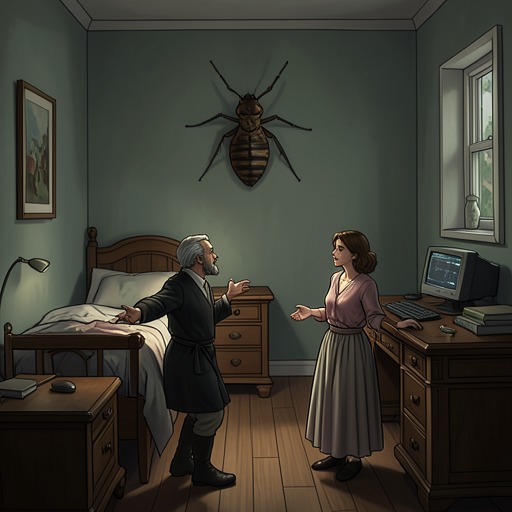
When Gregor climbs onto the framed picture of the woman in furs to protect it from removal, Mrs. Samsa sees the enormous brown patch of his body against the wallpaper. Before she fully understands what she is seeing, she cries out and collapses onto the couch as if she has surrendered everything. The picture becomes an especially charged object because it is one of the last remnants of Gregor’s former room; his effort to preserve it is also an effort to preserve an old human self, but to Mrs. Samsa the scene presents only an overwhelming animal presence.
Grete reacts by addressing Gregor directly and then running for smelling salts. Gregor tries to help, but a bottle falls, a splinter cuts his face, and caustic medicine splashes over him. Mrs. Samsa’s collapse transforms the room into a crisis in which Gregor is simultaneously the person who wants to assist his mother and the perceived cause of her danger. When Mr. Samsa returns, Grete tells him that Mrs. Samsa has fainted but is better and that Gregor has escaped. Mr. Samsa interprets the incomplete report as evidence of violence, and his anger leads directly to the apple attack.
During that attack, Mr. Samsa throws apples from the sideboard at Gregor. One lodges in Gregor’s back, producing an injury that remains for more than a month and permanently reduces his mobility. Mrs. Samsa intervenes not by confronting Gregor but by throwing herself toward her husband, her arms around him, and begging him to spare their son’s life. Her action is crucial: even at the moment when Gregor has become most visibly revolting and most easily treated as an enemy, she still identifies him as someone whose life must be protected.
The injury nevertheless changes the family’s practical relationship with Gregor. They cannot remove the apple, and it remains in his flesh as a visible reminder that the transformed body belongs, however painfully, to the family. Mrs. Samsa’s plea prevents the attack from becoming immediately fatal, but it does not restore communication or shared life. Gregor becomes less mobile, more dependent, and increasingly confined, while Mrs. Samsa’s protective impulse is left without the power to alter the household’s structure.
Final Exclusion and Aftermath
Later, when Grete declares that the family must get rid of the creature and stop believing that it is Gregor, Mrs. Samsa is present but physically overwhelmed. Grete argues that no human family can continue living with such an animal and that, if Gregor were still Gregor, he would understand this and leave of his own accord. Mrs. Samsa coughs dully, holds out her hand, and looks deranged with exhaustion. Her condition shows that the family’s crisis has become a bodily burden for her as well as a moral dispute.
When Gregor begins the slow, painful movement back toward his room, Grete panics and retreats behind Mr. Samsa. Mrs. Samsa remains in her chair with her legs stretched out and pressed together, her eyes nearly closed from exhaustion. She is not the architect of Gregor’s expulsion, but her silence and incapacity form part of the atmosphere in which that expulsion becomes possible. Grete closes and locks the door behind Gregor, and the family’s final boundary is established without Mrs. Samsa resisting it.
After Gregor’s death, Mrs. Samsa enters his room with Mr. Samsa and Grete. She sees his body, now completely dried up and flat, and makes a movement as if she wants to stop the Charwoman from shoving it with the broom, though she does not complete the gesture. Mr. Samsa gives thanks that the ordeal is over, and the women follow his example by crossing themselves. Mrs. Samsa’s incomplete movement captures her entire relation to Gregor: pity and attachment remain, but they no longer produce intervention.
The family then turns rapidly toward recovery. Mrs. Samsa and Grete embrace Mr. Samsa, finish writing letters of excuse, and leave the flat with him for a walk in the open country. On the tram they discuss their prospects, recognize that all three now have promising jobs, and agree that they should move into a smaller, cheaper, and more practical flat. Mrs. Samsa thus participates in the household’s restoration of function after Gregor’s death. Her grief is not denied, but the family’s new future depends on treating his absence as the condition under which ordinary life can resume.
Narrative Significance
Mrs. Samsa embodies the unstable boundary between familial recognition and rejection. She continues to call Gregor her son, hopes that his room can remain ready for his return, and begs Mr. Samsa to spare his life. Yet she also collapses at the sight of him, cannot enter his room for two weeks, and ultimately allows the family’s decision to exclude him to proceed. Her care is real, but it is constrained by fear, bodily weakness, household dependence, and the inability to communicate with Gregor.
Her position also clarifies how the family system changes across Gregor Samsa’s transformation. When Gregor is the provider, Mrs. Samsa can remain economically dependent and emotionally connected to him. When he becomes a body requiring care, Grete assumes the daily task of entering his room while Mrs. Samsa becomes a worried observer outside the door. When Gregor is injured and perceived as dangerous, Mrs. Samsa briefly forms a protective alliance with him by begging Mr. Samsa to stop. When the family finally identifies his continued presence as intolerable, her attachment cannot withstand the combined pressure of exhaustion and collective fear. After his death, she becomes part of the reorganized household that discovers employment, mobility, and a future beyond the room where Gregor was confined.